Project Overview
Millimeter wavelength radars have become an instrument of choice in hydrometeorological research for probing very small atmospheric particles, as small as 5 to 10 microns. These include nonprecipitating cloud droplets, fog, small ice crystals, supercooled liquid droplets, ice-water mixed phases and scatterers such as small insects and large aerosol particles, especially those undetectable by common weather radars. The most used and beneficial in the millimeter wavelength band are the W-band (frequency ~ 94 GHz, wavelength ~ 3.2 mm) and Ka-band (35 GHz, 8.6 mm) radars, also known as cloud radars. They have been used in atmospheric research since the 1980’s, impelled by concerns of the nexus between clouds and Earth’s climate as well as rapid advances in radar technology. Both Ka and W bands have intrinsic merits and disadvantages, but the advent of dual-frequency Ka-W band radars that conjoin Ka and W bands and exploit complementary advantages of both types has had profound implications in remote sensing of hydrometeors. A noteworthy development is the dual-frequency, Ka-W band, FMCW [frequency modulated continuous wave] radars produced by Radiometer-Physics GmbH (RPG) that integrate Ka and W band dual-polarized radars on a common scanning platform. The Ka-W combo operates Ka and W band radars synchronously in time with matched signal (range-bin) settings as a standalone, compact instrument. The unique advantages of such dual-frequency Ka-W band radars include: the ability to detect from very small (~ 5-10 microns) to relatively large (~5 mm) water droplets and ice aggregates (~ 1 cm), enabling the differentiation between regions of ice, cloud droplets, drizzle, mixed-phase hydrometeors and insects; profiling of liquid water content (LWC) and enhanced retrievals of Liquid Water Path (LWP); simultaneous retrieval of binned droplet-size distribution as well as high-resolution air state parameters such as vertical wind and air broadening caused by turbulence and wind shear; retrievals at low beam elevations; and rain profiling capabilities that are untenable by single-frequency cloud radars. In addition, the low weight and small dimensions of FMCW radars compared to magnetron (tube) based alternatives allow deployments on motion-stabilized platforms aboard research vessels.
Through this grant, University of Notre Dame acquired a dual-frequency, dual polarized, integrated Ka-W band radar system from RPG to support DOD-funded research in the environmental fluid mechanics group. The proposed dual frequency system became available recently, and the acquisition by University of Notre Dame (UND) is expected to be deployed in several future field campaigns on air-sea interactions funded by ONR and other agencies such as NOAA and DOE.
The advantages of Ka-W radar systems include: Reduction of the weight of Ka-band radars via solid state power amplifier technologies has enabled their utility in mobile platform applications, such as deployment on research vessels and aircraft; the solid-state signal of FMCW is cost effective and more reliable, especially in high moisture environments, vis-à-vis tube-based alternatives; a combination of frequencies allows longer probing range for hydrometeor properties (LWP, LWC); recently developed novel retrieval techniques enable evaluation of rain drop size distribution (DSD), retrieval of numerous microphysical properties (e.g., ice particle identification), evaluation of air state variables (e.g., vertical wind and air broadening by turbulence and wind shear), exploitation of special features observed in Doppler spectra caused by wavelength dependence of scattering and absorption and application of advanced mathematical inversion techniques like total variation regularization; validated Ka-W retrievals by comparing with other hydrometeor sensors; lighter weight of Ka-W combo FMCW radars favorable for usage with mobile platforms.
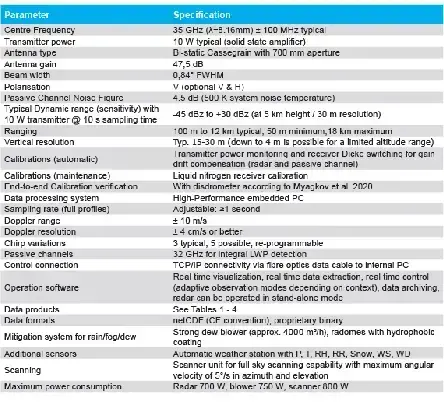
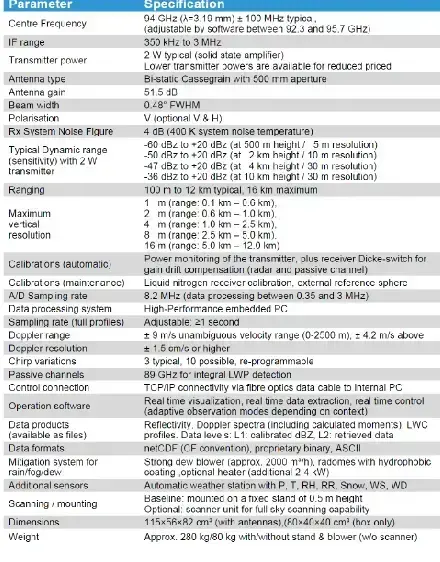
The specifications of the Ka and W-band follow: